top of page

Species Cards
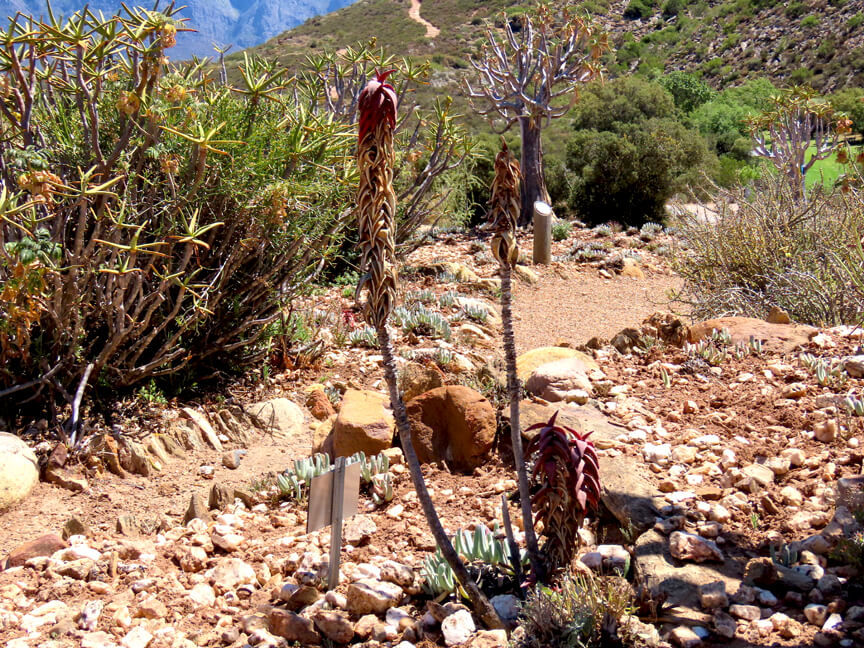
Aloe pearsonii

Rising temperatures and prolonged drought in the Richtersveld (2015–2020) caused major die-offs of Pearson's Aloe, which has very low recruitment and grows extremely slowly.

Pearson's Aloe

Pachypodium namaquanum

These trees are said in Nama folklore to be people turned into plants, forever facing north toward their lost homeland. Pachypodium namaquanum is highly poisonous and difficult to grow outside the Richtersveld.

Halfmens

Dicoma capensis

Eaten by insects and pollinated by bees, Dicoma capensis is used in traditional medicine to treat colds, fever, back pain, haemorrhoids, bladder infections, kidney problems, influenza, nausea, liver problems, stomach problems, diarrhea, and rheumatism, and as a bitter tonic.

Fever bush

Clivia mirabilis

Clivia mirabilis survives in an unusually arid environment compared with other Clivia species, which is why it is known as the “miracle lily”.

Miracle Clivia Lily

Erica sessiliflora

Erica sessiliflora is significant for its unique sunbird pollination and its fire-adapted serotiny. Endemic to South Africa, it is valued as a garden shrub that attracts birds. Sequencing its genome improves biodiversity knowledge and supports conservation.

Green heath

Erica plukenetii subsp. lineata

Erica plukenetii subsp. lineata is declining due to severe invasion by alien plants on the Agulhas Plain and is classified as Near Threatened on the IUCN Red List.

Plukenet's heath

Indigofera hamulosa

This species is native to the Cape provinces. Although little has been published specifically on Indigofera hamulosa, species in this genus are used in traditional medicine to treat gastrointestinal, inflammatory, skin, respiratory, and infectious conditions.

Flummoxed Indigo

Gazania krebsiana subsp. krebsiana

The subspecies, Gazania krebsiana subsp. krebsiana, is endemic to South Africa and Lesotho and is a parent of the spectacular hybrids grown commercially as ornamentals worldwide.

Gousblom

Wachendorfia multiflora

Wachendorfia multiflora has asymmetrical flowers, with styles deflected either to the right or left, resulting in roughly equal numbers of right- and left-morph plants.

Kleinrooikanol / Brown butterfly lily

Scelotes bipes

This species is an important model for investigating limb reduction and genomic evolution in vertebrates.

Silvery Dwarf Burrowing Skink

Erythrina afra

The Coastal Coral Tree is cherished for its warm red to burnt-orange flowers, blooming from winter to spring. Popular for its easy cultivation and long flowering period, it is an ideal garden plant, admired by botanists, horticulturists, and nature lovers.

Coastal Coral Tree

Barberetta aurea

Barberetta is a sister genus to Wachendorfia. A genome assembly of B. aurea from Karkloof (KZN) revealed the same supergene locus as Wachendorfia paniculata, while analyses of a Ngeli (KZN) population show substantial genetic differences.

Barberetta aurea

bottom of page